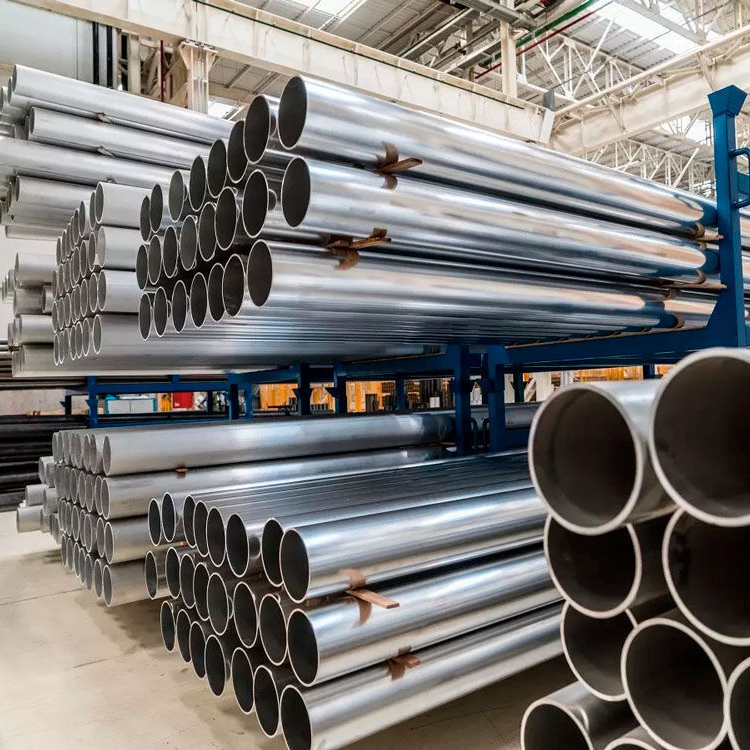
Stainless steel welded pipes are produced by forming stainless steel strip or plate into a cylindrical shape and joining the edges with a continuous longitudinal weld. The welding process creates a stable seam that integrates with the structure of the pipe, resulting in a product with reliable mechanical performance and high corrosion resistance. Because welded stainless pipes can be manufactured in a wide range of diameters, thicknesses, and finishes, they are used extensively across industrial, architectural, and mechanical applications.
Welded stainless steel pipes are known for their uniform wall thickness, consistent diameter, and clean surface quality. Their geometry makes them ideal for systems requiring predictable flow characteristics and ease of fabrication.
Typical properties include:
Smooth internal surfaces
Controlled dimensional tolerances
Availability in light to medium wall thicknesses
Suitability for low- to medium-pressure systems
Compatibility with various welding and fabrication methods
These characteristics allow welded pipes to be used in environments where corrosion resistance, hygiene, and visual quality are important.
The production of welded pipes follows a precise, standardized sequence:
Forming: Stainless steel coils or sheets are shaped into a circular profile using forming rolls.
Welding: The open edges are joined with TIG, laser, or high-frequency (HF) welding depending on the required specification.
Bead Treatment: The weld bead may be removed internally or externally to improve surface quality and flow characteristics.
Annealing: Heat treatment restores corrosion resistance and stabilizes the microstructure.
Pickling or Polishing: Surface treatments enhance appearance and cleanliness.
Sizing & Straightening: Final shaping ensures proper tolerances and uniformity.
The result is a tube with consistent roundness, straightness, and weld quality suitable for demanding industrial requirements.
Welded stainless steel pipes are available in a wide variety of sizes to match different project demands.
Typical supply ranges include:
Outside Diameter (OD): From small sanitary and mechanical tube sizes to large diameters used in ventilation and structural applications
Wall Thickness: Thin-wall to medium schedules depending on the standard
Length: Standard 6-meter lengths, with cutting available
Surface Finishes:
Annealed & Pickled (AP) – clean matte surface
Mill Finish – as-welded surface
Brushed / Satin – 180–320 grit for architectural applications
Polished / Bright Annealed – reflective surfaces for decorative or hygienic use
This diversity makes welded pipes suitable for visible installations, clean environments, and general-purpose fabrication.
Welded stainless steel pipes are manufactured according to global specifications that define chemical composition, dimensional tolerances, welding requirements, and testing procedures.
Common standards include:
ASTM A312 – Welded and seamless austenitic stainless steel pipe for general and pressure service
ASTM A778 – Welded, unannealed stainless pipes for low-pressure use
EN 10217-7 – Welded stainless tubes for pressure applications
EN 10296-2 – Welded tubes for mechanical and engineering applications
ASTM A554 – Welded stainless steel mechanical tubing for decorative, structural, and architectural applications. Provides requirements for surface finish, dimensional tolerances, and forming quality.
These standards ensure that welded pipes maintain consistent performance across temperature, flow, and corrosion conditions.
Because welded pipes offer a balance of corrosion resistance, dimensional accuracy, and cost-effective availability, they are utilized across many industries:
Food, beverage, and dairy processing systems
Architectural structures, railings, and support frames
Ventilation ducts, exhaust systems, and HVAC pipelines
Chemical and water transfer lines
Machinery guards, equipment enclosures, and frameworks
Cooling and process fluid systems
Automotive applications including exhaust and fabrication work
Their smooth internal bore and clean surface quality make them suitable for hygienic applications, while their structural stability suits both visible and concealed installations.
You can contact us for more information about Welded Pipe.